
A neutral reading of performance, approval, and safety
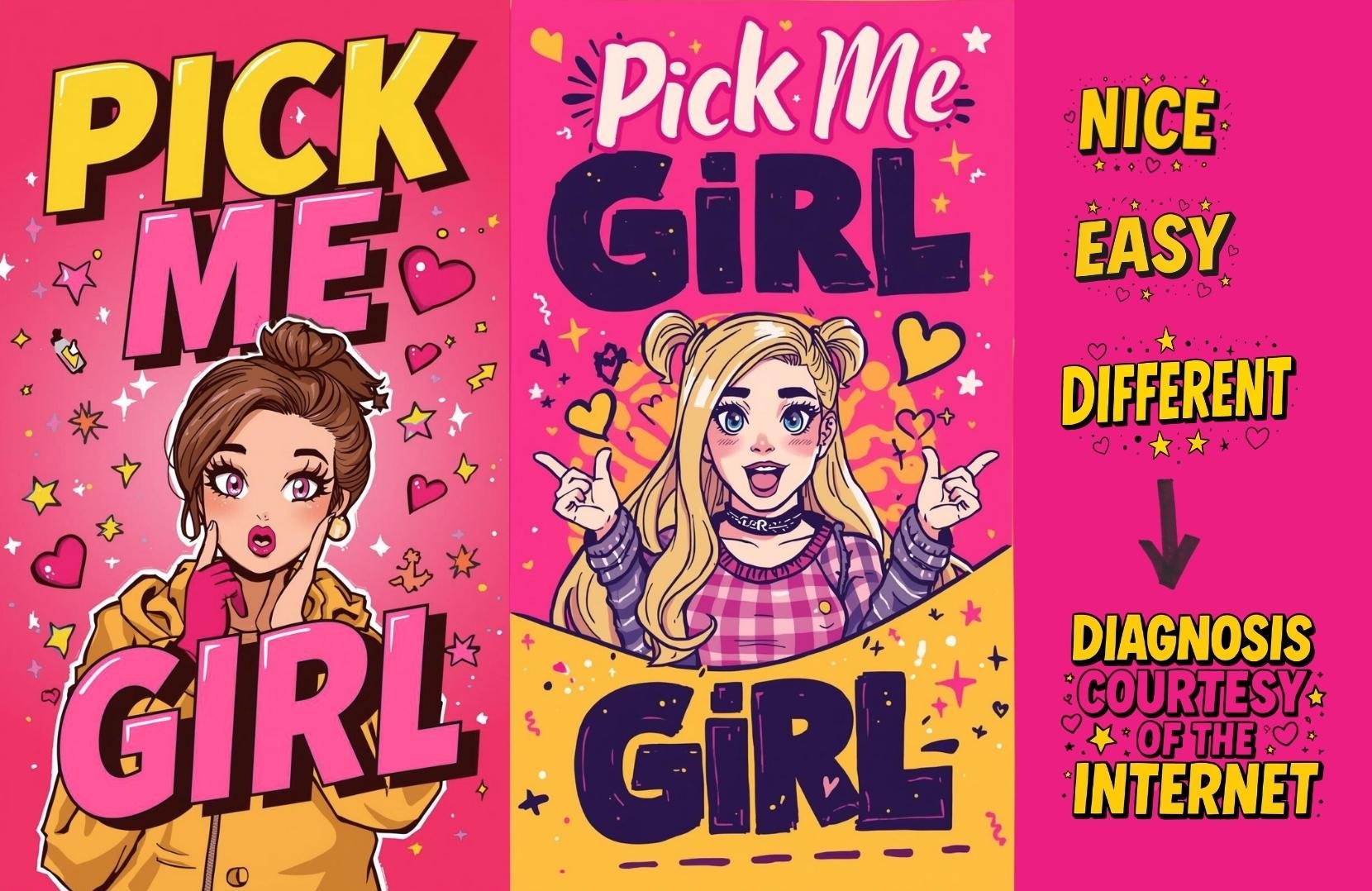
Pick me girl – “Pick me girl” travels fast. It doesn’t need explanation anymore. One word and everyone knows the vibe.
The girl who says she’s not like other girls, the one who laughs a little too hard in front of men, the one who insists she’s low-maintenance, chill, drama-free.
The term feels clean. Efficient. Slightly superior.
But here’s what’s interesting: we often use it like a personality diagnosis, when most of the time it’s closer to social survival.
Humans are wired to want inclusion, not in a poetic way, but in a nervous-system way. Research shows that social rejection activates the same brain regions as physical pain. Being excluded doesn’t just hurt emotionally; the body reads it as threat. So people adjust.
Growing up, you start noticing who gets mocked.
Soon you notice which girls are labeled “too much.”
At the same time, you see who gets picked, for friendships, dating, or opportunities, and without consciously deciding, people start optimizing. Maybe that looks like saying, “I’m not like them.” Maybe it looks like distancing yourself from stereotyped femininity. Sometimes it simply means trying to be the easiest person in the room to keep around.
From the outside, it reads as performance. From the inside, it often feels like strategy learned early.
Pick me girl – When Belonging Turns Into Performance
However, that doesn’t mean it’s harmless.
When someone repeatedly throws other women under the bus to look better, that isn’t neutral. Instead, it reinforces the same hierarchy that made her anxious in the first place. For that reason, criticism is sometimes justified.
Still, this is where Gen Z can move a little too quickly with the label. Not every attempt to be liked is betrayal, not every socially anxious girl is anti-woman, not every soft-spoken woman is calculating. Sometimes she’s simply reading the room.
Sociologists have been writing about this for decades. They call it impression management, the way people adjust how they present themselves depending on context. Everyone edits a little. The real difference is how much you shrink in the process, and whether someone else gets smaller so you can look bigger.
That’s where the line appears. Over time, something else often happens.
When someone feels secure enough that being chosen isn’t oxygen anymore, the performance relaxes. The comparisons fade. The “I’m different” energy softens. Belonging stops feeling fragile. Most people grow into that.
The girls we call “pick me girl” aren’t a fixed archetype. In reality, they’re often just earlier in that evolution, still calibrating, still figuring out how to belong without slicing off pieces of themselves. Some will stay stuck. Some won’t.
Pick Me girl – Is she shrinking herself or shrinking someone else?
What’s worth asking isn’t simply, “Is she a pick me?” It’s: who has to shrink for this to work?
That’s a better filter.
Because wanting to be chosen is human, however, needing to step on someone to feel chosen, that’s the part worth outgrowing, and most people, quietly, eventually do.
And maybe there’s something else worth noticing. There’s also social currency in spotting the “pick me.” It signals awareness. Alignment. That you understand the rules of the room.
Sometimes the call-out protects people — and sometimes it protects the caller. At other times, it simply reorders the hierarchy.
Belonging shifts. Performance shifts. The audience changes. Who’s auditioning, and for whom, isn’t always obvious.
Let’s think about it.
References
Baumeister, R. F., & Leary, M. R. (1995). The need to belong: Desire for interpersonal attachments as a fundamental human motivation. Psychological Bulletin, 117(3), 497–529. https://doi.org/10.1037/0033-2909.117.3.497
Eisenberger, N. I., Lieberman, M. D., & Williams, K. D. (2003). Does rejection hurt? An fMRI study of social exclusion. Science, 302(5643), 290–292. https://doi.org/10.1126/science.1089134
Goffman, E. (1959). The presentation of self in everyday life. New York, NY: Anchor Books.
Ridgeway, C. L. (2011). Framed by gender: How gender inequality persists in the modern world. New York, NY: Oxford University Press.
Further Reading
If this topic made you pause for a second, these pieces explore the same quiet mechanics of belonging, boundaries, and emotional survival.