Powerful women shrinking themselves – Taylor Swift, Hayley Williams, and the quiet cultural script that still shapes powerful women.
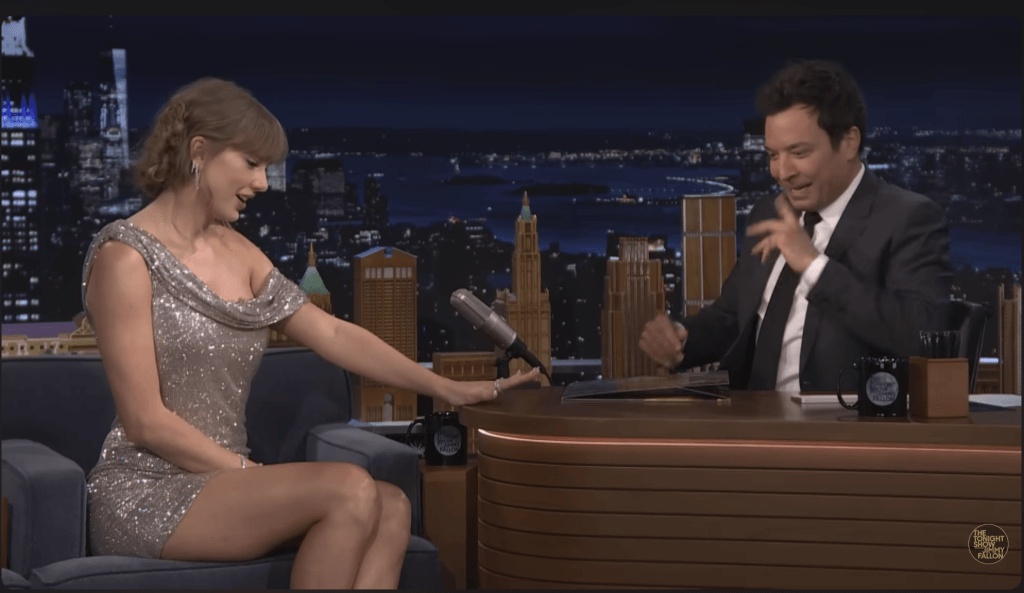
TikTok has a habit of resurrecting old moments and turning them into fresh arguments. This week it decided to bring back a clip of Taylor Swift on The Tonight Show Starring Jimmy Fallon.
In the video, Swift described her boyfriend Travis Kelce’s job as an NFL player as someone who “puts his life on the line.” Within hours, the internet did what the internet always does: it started laughing.
Memes appeared.
Comment sections filled with jokes pointing out that NFL players are not soldiers going to war.
Some people called the statement exaggerated. Others found it strangely revealing.
And maybe the exaggeration was the point.
Because the interesting question is not whether football is dangerous.
The interesting question is why the most powerful pop star on the planet suddenly sounded like someone trying very hard to elevate the importance of the man beside her.
Taylor is not just successful. She is arguably the most commercially dominant musician of our generation. Her tours reshape city economies. Her albums redefine streaming records. She is, by most metrics, one of the most powerful entertainers alive.
Yet in that moment she sounded almost… careful.
Careful to make sure the man next to her still appeared heroic.
Not maliciously. Not consciously. Just instinctively.
Two days later, another moment on the same show went viral for a completely different reason.
Hayley Williams appeared on Fallon and performed a song addressing political and cultural tensions in the United States. The performance referenced themes of racial violence and Christian nationalism, and it closed with an orchestral nod to Billie Holiday’s Strange Fruit, a haunting symbol of American history.
The internet reaction was almost the opposite.
Instead of mocking her, people praised the moment. They shared the clip as an example of an artist using her platform responsibly.
Two women.
Same stage.
Same week.
But two completely different conversations.
One became a meme about exaggerating male heroism.
The other became a moment about speaking truth through art.
And the contrast reveals something deeper than pop culture gossip.
Powerful women shrinking themselves – The Invisible Script
Social psychologists describe something called benevolent sexism.
Unlike overt sexism, benevolent sexism does not sound hostile. It sounds flattering. It praises women as caring, nurturing, supportive, emotionally wise.
But underneath the compliments, the structure remains the same.
Men are associated with strength, protection, and authority.
Women are associated with emotional support and admiration.
The system works because it feels polite.
Which means even extremely powerful women sometimes instinctively participate in reinforcing male importance.
Not because they are weak.
But because the cultural script is older than any one person.
The Problem With Being on Top
There is another psychological idea that helps explain this dynamic: role congruity theory.
Research suggests that when women occupy positions associated with power, authority, or leadership, they often face a paradox.
If they behave too assertively, they are criticized for being aggressive.
If they soften their power, they are praised for being likable.
In other words, success does not remove gender expectations.
It just makes the balancing act more visible.
Which means that the higher a woman climbs, the more carefully she may feel the need to perform humility, warmth, and relational loyalty.
Sometimes that performance looks like elevating the man next to her.
Even if she is objectively the more powerful person in the room.
The Internet’s Strange Double Standard

This is where the viral reaction becomes interesting.
The internet mocked Swift for exaggerating a man’s heroism.
But the same internet also tends to punish women who appear too dominant, too self-focused, or too dismissive of the men around them.
Women are allowed to be extraordinary.
But they are still expected to remain socially reassuring.
Hayley Williams’ moment worked because her message expanded outward, toward society, politics, and collective history.
Taylor’s moment focused inward, toward a romantic relationship.
Neither moment is inherently wrong.
But the contrast exposes something about the cultural expectations placed on women with massive influence.
Sometimes the more powerful a woman becomes, the more carefully she must demonstrate that she is still emotionally supportive.
Still respectful.
Still willing to make space.
Powerful women shrinking themselves – The Quiet Cost of Power
Which leads to a strange cultural question.
At what point does being the most powerful woman in the room require pretending you are not?
Not completely.
Just enough to keep the social balance comfortable.
Maybe Taylor was simply being affectionate.
Maybe she was joking.
Or maybe she was instinctively doing something millions of women do every day:
Inflating the importance of the men around them so that their own success feels less threatening.
And if that’s the case, the moment becomes less about Taylor Swift and more about something bigger.
Because even at the very top of the cultural hierarchy, women are still negotiating how large they are allowed to be.
And sometimes the quiet price of standing on top is learning how to make yourself slightly smaller.
Because sometimes the quiet price of becoming the most powerful woman in the room is learning exactly how small you still need to appear.
References
Glick, P., & Fiske, S. T. (1996). The ambivalent sexism inventory: Differentiating hostile and benevolent sexism. Journal of Personality and Social Psychology, 70(3), 491–512. https://doi.org/10.1037/0022-3514.70.3.491
Heilman, M. E., & Okimoto, T. G. (2007). Why are women penalized for success at male tasks? The implied communality deficit. Journal of Applied Psychology, 92(1), 81–92. https://doi.org/10.1037/0021-9010.92.1.81
Rudman, L. A., & Phelan, J. E. (2008). Backlash effects for disconfirming gender stereotypes in organizations. Research in Organizational Behavior, 28, 61–79. https://doi.org/10.1016/j.riob.2008.04.003
Vandello, J. A., & Bosson, J. K. (2013). Hard won and easily lost: A review and synthesis of theory and research on precarious manhood. Psychology of Men & Masculinity, 14(2), 101–113. https://doi.org/10.1037/a0029826
Jack, D. C., & Dill, D. (1992). The silencing the self scale: Schemas of intimacy associated with depression in women. Psychology of Women Quarterly, 16(1), 97–106. https://doi.org/10.1111/j.1471-6402.1992.tb00242.x
Eagly, A. H., & Karau, S. J. (2002). Role congruity theory of prejudice toward female leaders. Psychological Review, 109(3), 573–598. https://doi.org/10.1037/0033-295X.109.3.573
Reuters. (2025, October 7). Taylor Swift too ‘locked in’ with Chiefs to do Super Bowl halftime show. https://www.reuters.com/sports/taylor-swift-too-locked-in-chiefs-do-super-bowl-halftime–flm-2025-10-07/
People Magazine. (2025, October 6). Taylor Swift addresses Super Bowl halftime rumors during Jimmy Fallon appearance. https://people.com/taylor-swift-debunks-super-bowl-halftime-show-rumors-with-jimmy-fallon-11825298
NYS Music. (2025, October 11). Hayley Williams delivers powerful message on The Tonight Show. https://nysmusic.com/2025/10/11/hayley-williams-delivers-powerful-message-on-the-tonight-show/
Further Reading
If this dynamic feels familiar, these pieces explore how women are still quietly expected to shrink themselves, in relationships, in culture, and sometimes even at the height of their power.
- Pick Me Girls: The Lives Behind the Label
- Taylor Swift Owns Her Masters! What That Means for Music, Artists, and the Industry
- The Top-Tier Man: When Trying Looks Like Gold – and Society Approves
- Woman of the Hour: Why Survival Doesn’t Always Look Like Screaming
- The Male Loneliness Epidemic: Is Equality Killing Men or Was It Always This Empty?